Bjarke's Homemade Snowplough
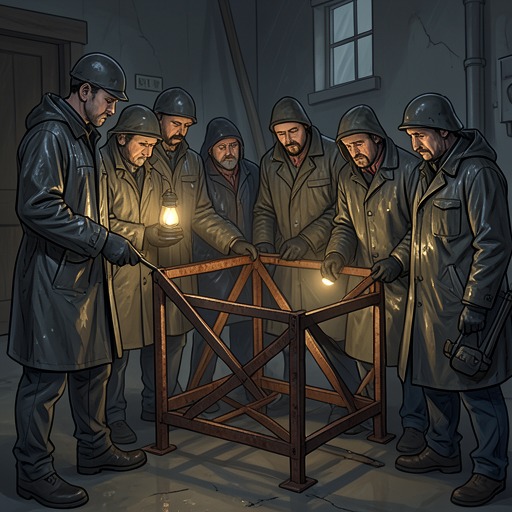
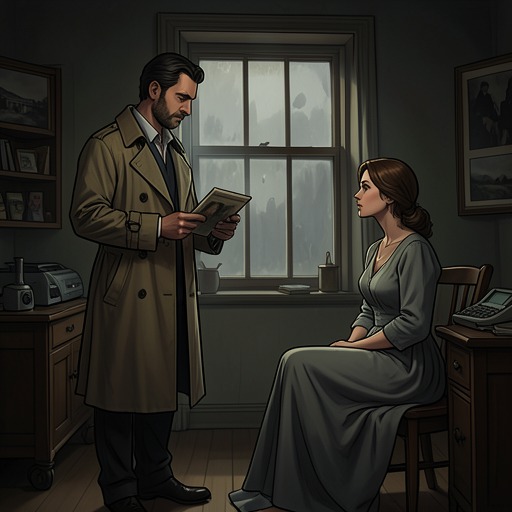
The Hanging GirlBjarke's Homemade Snowplough is a homemade vehicle attachment that links Bjarke's Christmas-tree enterprise to June Habersaat's murder of Alberte Goldschmid. Its cheerful sales sign helps conceal the purpose for which June uses it: what appears to be a Boy Scout's seasonal contraption becomes a means of making a deliberate collision look harmless until the last moment.
Construction and First Appearance
In the photograph that changes the investigation, Bjarke stands beside a four-wheel drive with a plow mounted on it. He is wearing his Boy Scout uniform, cap, shoulder cord and a belt knife decorated with small shields. His broad grin suggests pride not only in his troop assistant distinctions and the vehicle, but in the homemade attachment itself. The plow carries a large white Christmas-tree-sale message: “BOY SCOUT GRAND CHRISTMAS TREE SALE—MERRY CHRISTMAS”. The book presents it as part of a likely charitable enterprise, a public-facing project that makes the object seem ordinary and even benevolent.
The photograph matters because the plow is an identifiable trace of Bjarke's activity. Christian Habersaat recalls finding it after Alberte's death, when the island was searching for it, and understanding it as something Bjarke had apparently used to sell Christmas trees. That discovery intensified Christian's suspicion of his son, even though the evidence he was pursuing also pointed toward Frank, June's former lover. The plow's association with Bjarke thus enters the case not as a neutral detail but as a clue shaped by competing suspicions.
June's Use of the Plow
June's account reveals a second, more dangerous use. She says she borrowed her son's car while he was working at a workshop in Aakirkeby, where he left it in front of his sister's house to have lunch. She then took the snowplow, which Bjarke had welded himself and which was lying in the garage at Listed, and loaded it into her own car. At Jernbanegade, she attached it to the fender of the Toyota, fitting it as it had been constructed to fit.
The attachment allowed June to approach Alberte under the guise of driving a snowplow. Alberte was standing by the roadside, and the incongruous sight of the machine—bearing its Christmas message despite there being no snow and Christmas still more than a month away—made her smile. June says she made it seem that she was steering around Alberte, then jerked the wheel and drove into her, striking Alberte first and her bicycle next. The sign's festive absurdity was not incidental decoration: it helped sustain the appearance of an innocent passing encounter until June turned the vehicle into a weapon.
June also explains how she sought to prevent the impact from leaving a mark on the car: the snowplow was attached at the fender, where it could take the contact. Her account makes the object part of a planned concealment, not simply a device present at the scene. The same construction that made it fit a vehicle for a Christmas-tree sale made it usable for the collision she had arranged.
Clue, Misdirection, and Reversal
The snowplow's evidentiary meaning shifts as the investigation develops. Christian's discovery seemed to connect Bjarke to the case, while other indications—including the splint found at the crime scene—gave him reason to hope that his son was not responsible. Christian's suspicions moved between Bjarke and Frank, and the search for the man associated with a VW Kombi continued. The object therefore belongs to a chain of leads that investigators interpreted through incomplete and sometimes misleading evidence.
The photograph overturns the investigators' working assumptions. They had come to Bornholm to protect June from Frank; the image makes clear that the danger had run in the opposite direction. June's confession then supplies the missing connection between Bjarke's handmade plow and Alberte's death. The object had genuinely belonged to Bjarke's everyday activity, but its presence in the crime's history did not mean that he had driven the fatal attack. June appropriated its usefulness and its innocent appearance.
Narrative Significance
The plow's importance lies in the sharp difference between its public meaning and its criminal function. In Bjarke's photograph it belongs to a cheerful, practical venture, decorated with an unmistakable Christmas greeting; in June's account it becomes an instrument of disguise, positioned on a car to make an attack resemble an attempt to pass by. Its material design carries the plot across that divide: a welded attachment, made to fit a vehicle, can be transferred to another car and put to a purpose its maker's photograph does not disclose.
That double use also explains why the object could misdirect the investigation without being irrelevant. It points back to Bjarke because he made it and used it, yet June's later explanation shows how someone else could turn it against Alberte. The plow is therefore both a tangible clue and a misleading one: it preserves a true connection to Bjarke while concealing the identity of the person who used it to kill.